

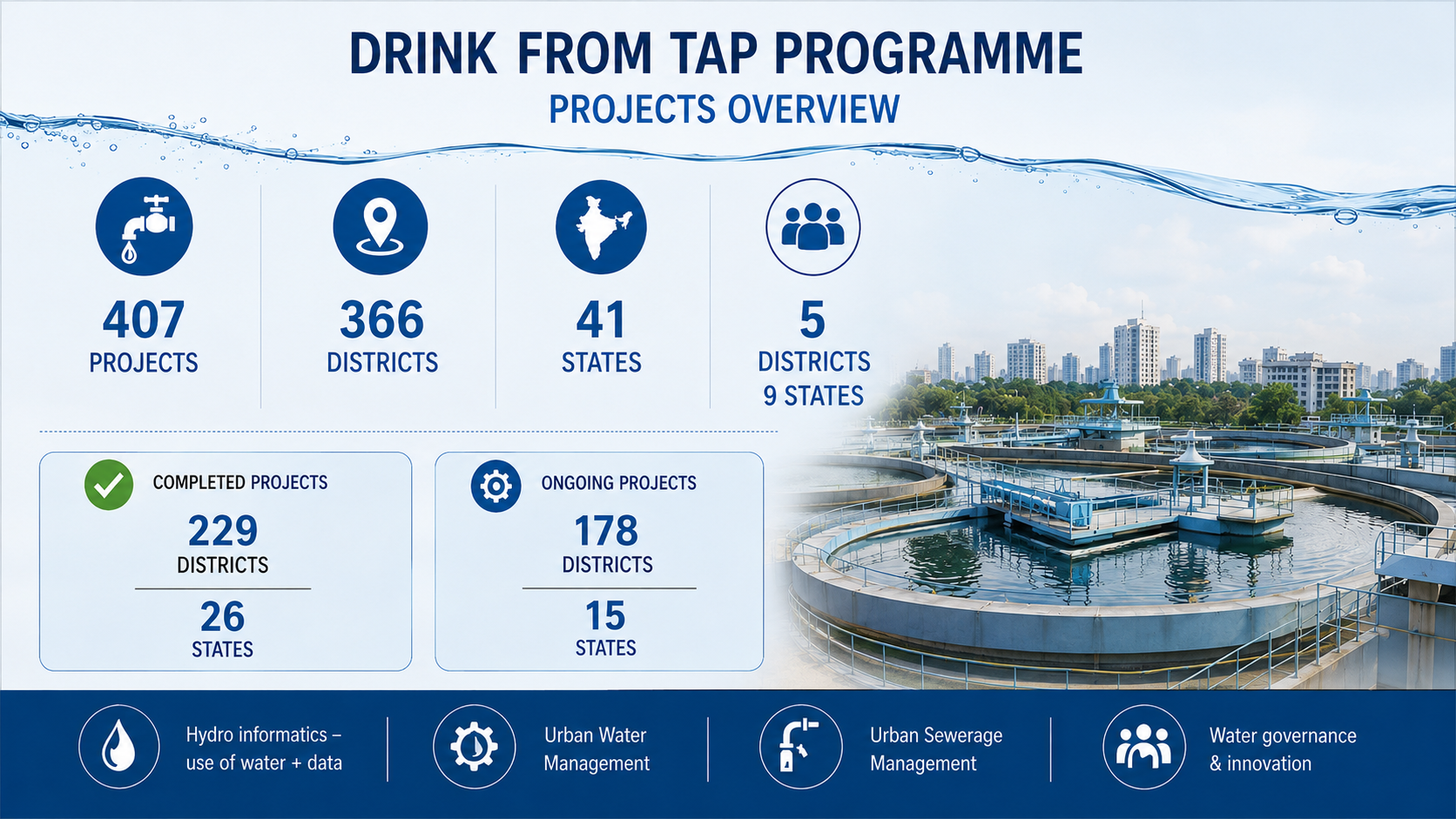
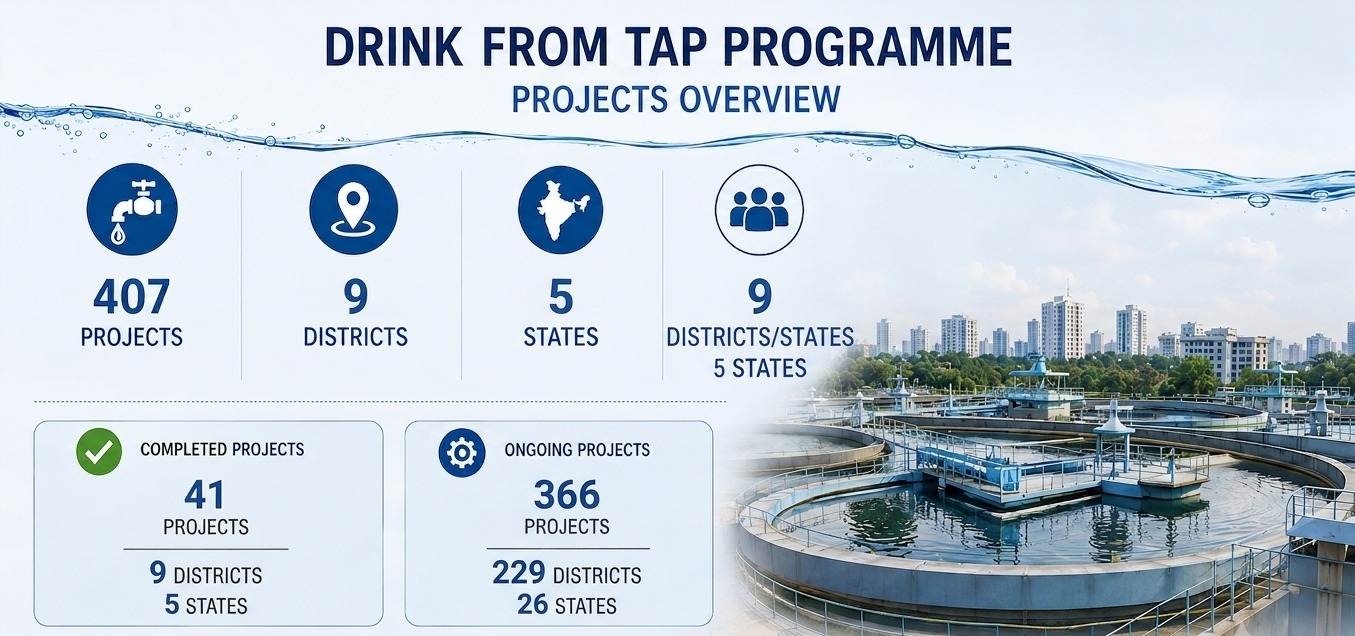
The Ministry of Housing and Urban Affairs, Government of India, has entrusted the AMRUT Centre of Urban Planning for Capacity Building, School of Planning and Architecture Vijayawada (ACUPCB-SPAV), with the Advocacy Research of Impact Assessment of DfT Programme under AMRUT-MoHUA-GoI (ADV_26_01) The Project aims at evaluating the implementation, performance, outcomes, and impacts of the Drink from Tap (DfT) programme, an initiative,under AMRUT 2.0 (2021-26), that aims to provide continuous, pressurised 24×7 potable water supply directly to household taps. The programme targets contamination reduction, lower household costs, reduced water losses, and improved public trust in tap water. It promotes water-secure cities in line with AatmaNirbhar Bharat, reduces storage and pumping requirements, ensures equitable water distribution, and minimises Non-Revenue Water (NRW).
The study aims to establish national-level programme coverage, identify representative cities, understand urban morphology and water supply characteristics, and assess interventions against 9 indicators and 86 parameters. It also seeks to identify implementation gaps, success factors, and good practices, and recommend measures to enhance the scalability and replicability of successful interventions.
Five case study cities-Puri, Coimbatore, Nagpur, Dehradun, and Tezpur have been selected for detailed assessment. The selection considers physical project completion, the number of household beneficiaries, utilisation of sanctioned funds, and geographical representation across India.
Through detailed city-level analysis, the study will generate evidence-based insights and actionable recommendations to strengthen programme implementation, improve urban water supply systems, and inform future policy decisions towards sustainable, reliable, and equitable drinking water provision.